 Written by
 Bessie (1898-1993)
After my parents divorced, when my brother and I were still little, we used to go and stay with our paternal grandmother, Bessie, or to us, ‘Granny’, in her small one bedroom flat in Finchley, London. Dad would pick us up every other Saturday morning and drive us down to London. He’d then stay for the afternoon, sitting in the arm chair, chain smoking and watching ‘Grandstand’ before leaving to go back to his house in London sometime between the start of the Basil Brush show and the beginning of Doctor Who. Gus and I loved staying with Granny. We still reminisce about her famous beef stew served with tinned boiled potatoes and peas, bacon and baked beans for breakfast, and those slabs of square 70’s Pizza – which she mispronounced in an anglicised ‘Pizzer’.
She had a standing writing desk in her sitting room and in one of the draws she had a few old photos. Granny sitting in the front row of a school room aged around seven, my father and his brother on horses, my deceased grandfather Keith.
Granny had a sister, who we met on a number of occasions, who we called ‘Auntie Mary’ (had a canary etc etc..) but that was all we knew about Granny’s family.
I remember asking her once “Granny, did you have any brothers?”
“They were killed in the war” she replied. And I could see the memory had upset her.
So I didn’t ask her any more questions about them.
Charles Louis Peace (1892-1916)
When my daughter started investigating our family tree in the Summer of 2024 she quickly revealed that Bessie had had two older brothers. Charles Louis Peace, born 1892, and Roland Cartwright Peace, born in 1895.
Bessie was born in 1898 so Charles was 6 years her elder. Their parents were Charles and Esther, and Granny also had two sisters, Mary and Edith. (Edith married the brother of my grandfather Keith – Dudley Kimber). The family lived in Walsall, Staffordshire (as was then). Charles Senior worked as a Saddler’s Ironmonger, a specialised trade in the making and selling of the iron and metal fittings used in horse tack and harnesses.
On the 18th November 1910, at the age of 18, Charles is recorded as an incoming passenger on the ship ‘Virginian’ arriving at Nova Scotia, Canada. In 1913 he has a letter published in the Walsall Advertiser on the benefits of the licensing laws in Ottowa, where he resided, compared to Walsall. One gets the impression he wasn’t a drinker, or at least strongly favoured the stricter opening hours. But also still very much in touch with his homeland it would seem.
And then, on the 7th November 1914 he signed his attestation papers for the Canadian Overseas Expeditionary Force. He is listed as unmarried and working as a Clerk. He joined the 21st Battalion, Canadian Infantry.
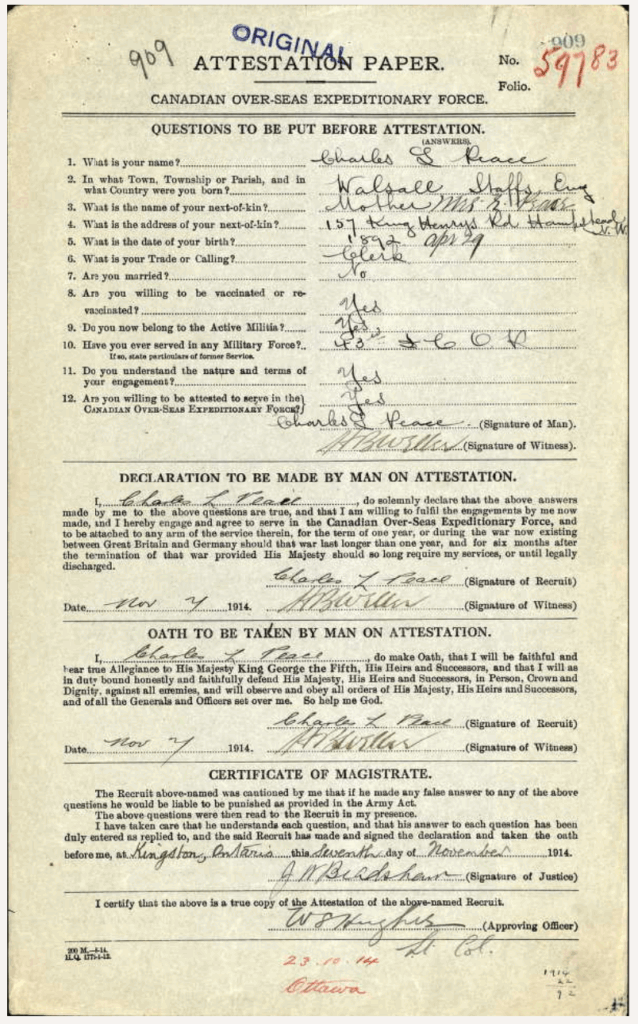
On the 21st Battalion memorial website it says:
“The 21st Battalion, which was authorized on 7 November 1914 as the 21st Battalion, Canadian Expeditionary Force, embarked for Britain on 6 May 1915. It disembarked in France on 15 September 1915, where it fought as part of the 4th Infantry Brigade, 2nd Canadian Division in France and Flanders until the end of the war. The battalion was disbanded on 30 August 1920.”
The website also notes the heavy cost paid by the battalion in the fighting on the western front:
“In May of 1915, 1,013 men left Kingston with the Battalion, but when they marched into Germany at war’s end, only 103 remained.”
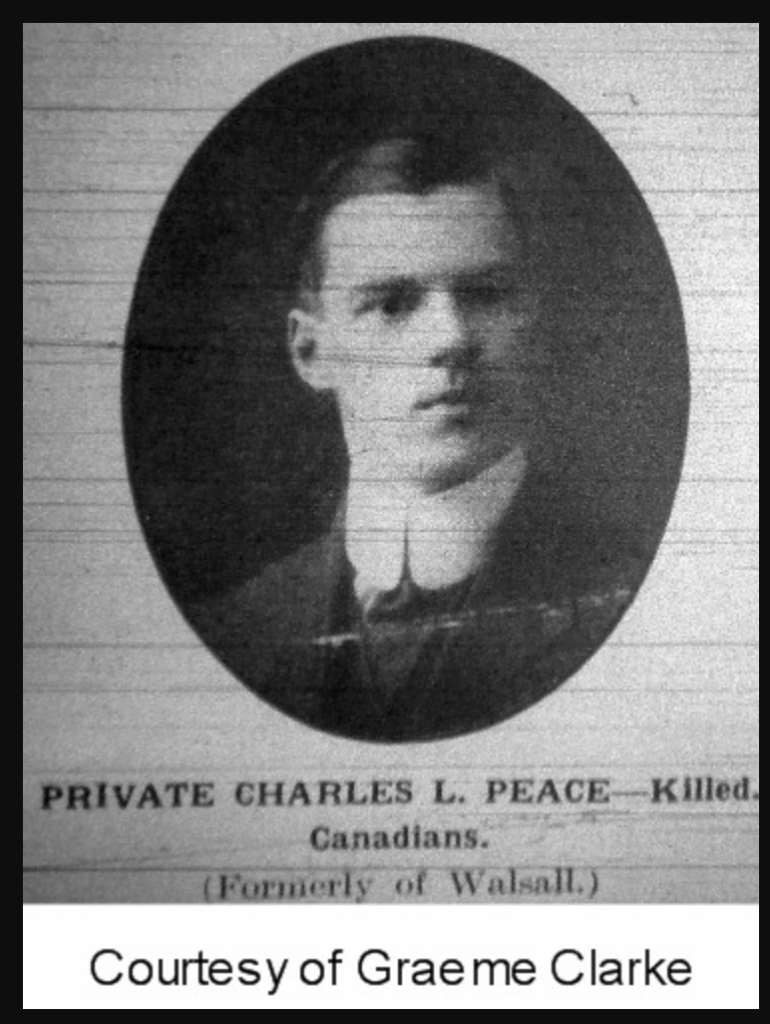
Sadly, Charles was not one of the lucky ones. He was killed on the 12th June, 1916, aged 24, in the Battle of Mount Sorrel. There is an excellent website dedicated to the 21st Battalion, and Charles has a page here: https://21stbattalion.ca/tributeos/peace_cl.html
It states that:
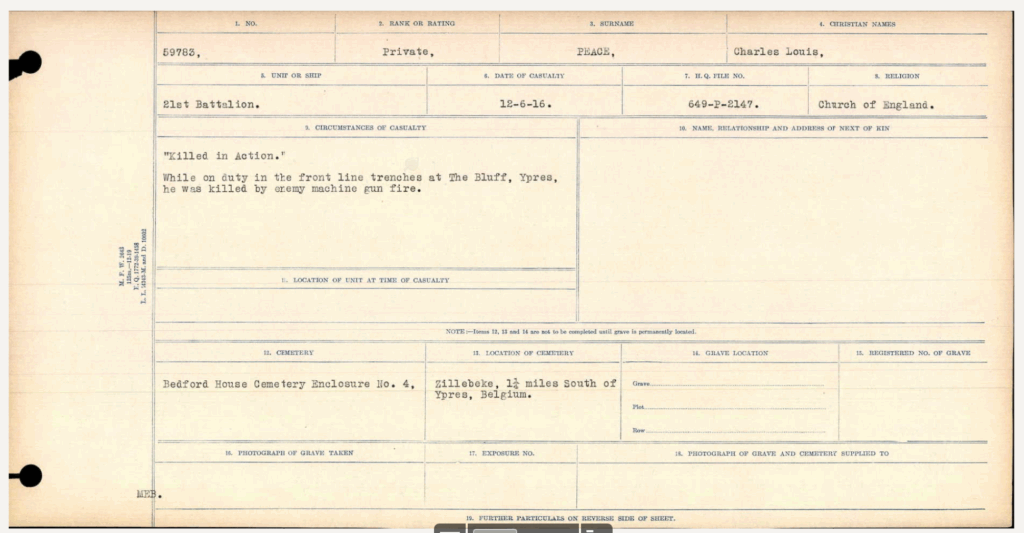
“While in the front line 33 to 38 trenches between Dickebusch and Vander Molen, Belgium, Private Charles Peace was killed instantly by a machine gun bullet to his head. He was buried in the Bedford House Cemetery, Ypres, Belgium”
Below is the ‘circumstances of casualty’ report from his military record:
And this is the war diary entry from the 21st Battalion for the 12th June:

Charles Louis is buried at the Bedford House War Cemetery in Belgium:
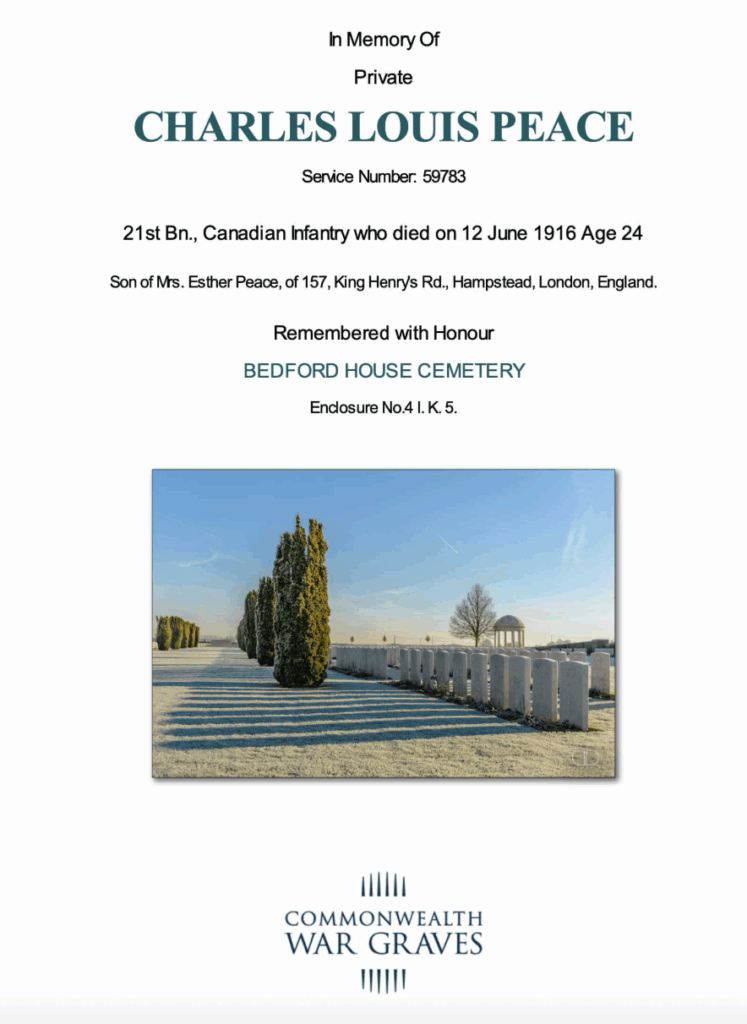
Roland (1895-1916)
I have less detail on Roland’s life. In the 1911 census he is listed, aged 16, as living on his Uncle and maternal Aunt’s farm at Manor Farm, Tillington, Stafford. His occupation is listed as ‘Draper’.
The Canadian sources for Charles are excellent but I have found less information for Roland, or Rowland, as he is listed in military records. At the outbreak of the war it looks like he joined the 18th Battalion the Royal Fusiliers, City of London Regiment. The 18th Battalion were disbanded in April 1916 and it seems Roland was transferred to the 10th Battalion.
On the excellent ‘Long, Long Trail’ website by Chris Baker there is this information on his battalion:
“10th (Service) Battalion
Formed in City of London in August 1914 as part of K2, although it was a locally raised battalion, not under the control of the War Office – and had the unofficial title of the Stockbrokers.
September 1914 : came under command of 54th Brigade, 18th (Eastern) Division.
October 1914 : left Brigade and became Army Troops in same Division.
March 1915 : transferred to 111th Brigade, 37th Division.
Landed at Boulogne 30 July 1915.”
It seems Roland had made his way to London and found work in the City, in all likelihood as a ‘humble clerk’. According to the Western Front Association website:
“The Stockbrokers’ Battalion can justly claim to be the first of the volunteer Pals’ Battalions of the Great War. Its members ranged from wealthy bankers like the Rothschilds, to humble clerks in the City of London. The Battalion fought throughout the war on the western front from July 1915 to the Armistice.”
The Wikipedia page for the battalion states:
The 10th (Service) Battalion, Royal Fusiliers (Stockbrokers) (10th RF) was an infantry unit of ‘Kitchener’s Army‘ in World War I. Recruited from the financial community of the City of London it was the original ‘Pals battalion‘. It served on the Western Front from July 1915 until the Armistice, seeing action at the Somme and the Ancre, at Arras and Ypres, against the German spring offensive, and in the final Hundred Days Offensive.
Many WWI records were destroyed in the Blitz in WWII, but from the date of his death we can devise that Roland was killed at the battle of Ancre, “the last of the big British attacks in the Battle of the Somme”. From the Wikipedia page:
“37th Division took over command of the sector on 15 November, and that night 10th RF was sent up to relieve 13th KRRC, discovering and capturing a party of Germans still in the trenches when they arrived. At dawn the battalion attacked a group of trenches known as the ‘Triangle’, but was driven back by rifle fire; a bombing party reached the Triangle in the afternoon but was also driven back. The battalion was next ordered to occupy Muck Trench and establish a chain of four strongpoints along 600 yards (550 m) of its length. Although the trench was reached it was under shellfire and the strongpoints could not be established in daylight; eventually the two left posts were set up after dark”
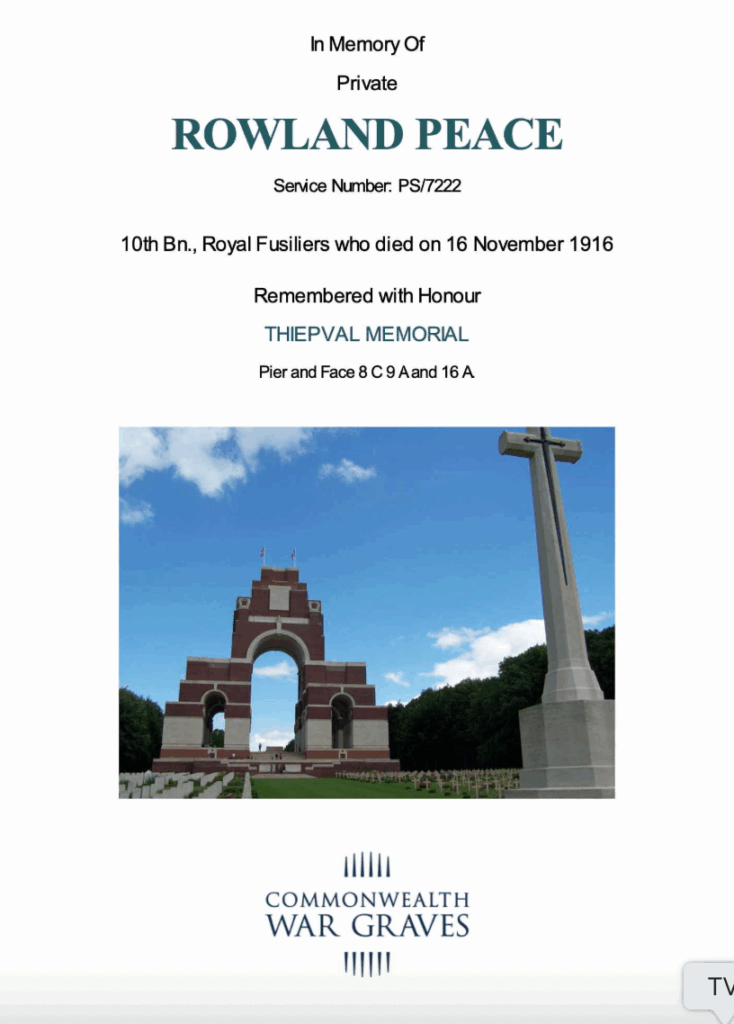
At some point in the battle Rowland was killed. He is remembered on the Thiepval memorial.
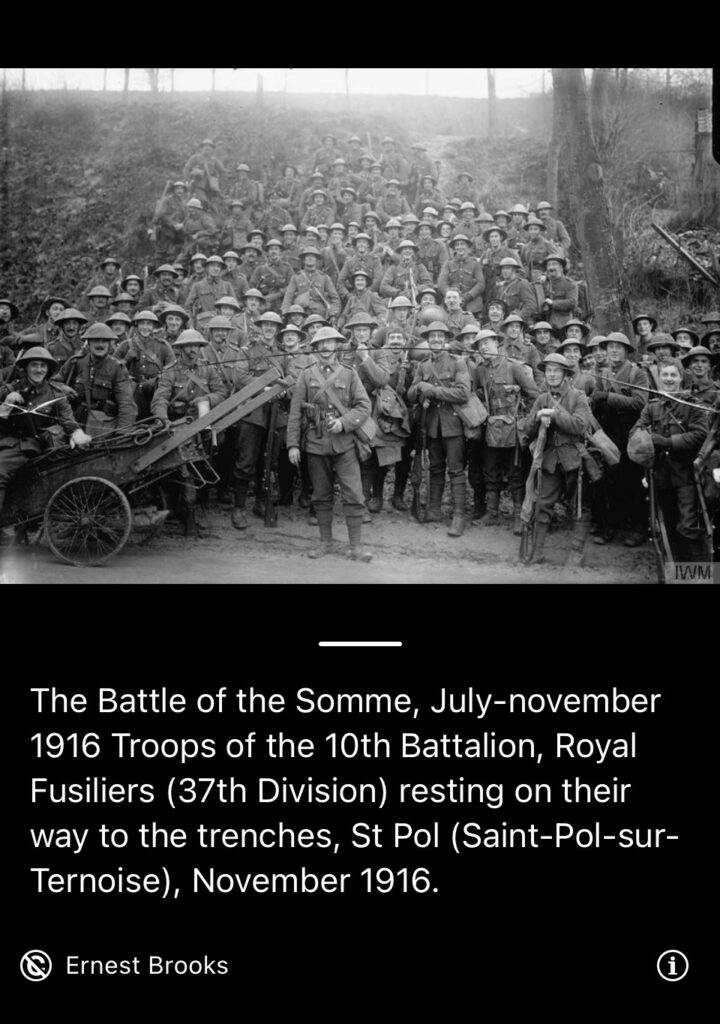
I also found this picture online – Is Roland in there somewhere?
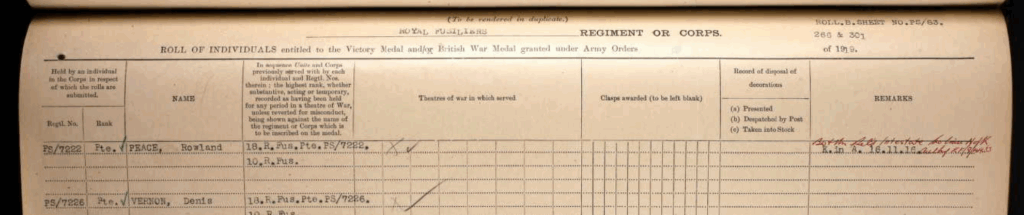
But there is an even sadder and poignant post-script. There are two other military records I found.
This is his medal index card. He was awarded the 1914–15 Star, British War Medal, and Victory Medal.
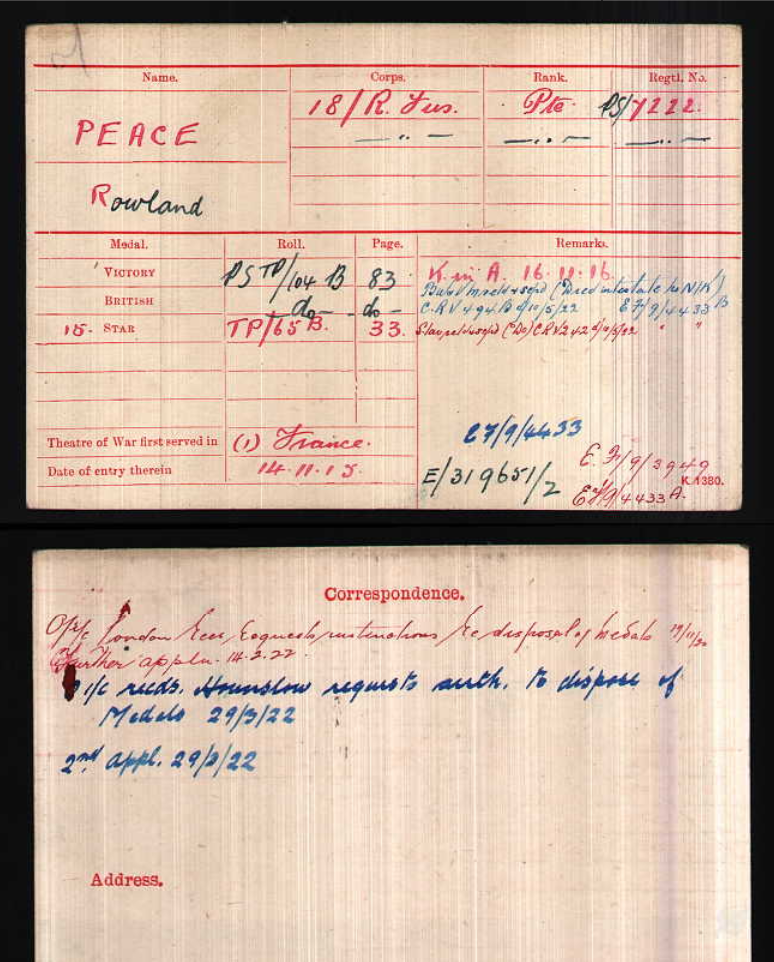
But this record seems to state ‘No trace N of K’ – no trace next of kin.
And then reading the second page of the medal index card it clearly states that Roland had died intestate, without a will, and no next of kin had been found. And so it was requested that the medals be sent for disposal.
ChatGPT was better able to decipher the handwriting:
Offg London Regt. Enquired instructions re disposal of medals 11/2/22
Further appln. 14/3/22
The officer in charge of the London Regiment office wrote to ask what should be done with Rowland’s medals on 11 February 1922, then followed up again on 14 March 1922.
Then in blue ink:
I/C Medals Hounslow requests auth. to dispose of Medals 29/3/22
2nd appl. 29/3/22
So the Officer in Charge of Medals at Hounslow (the Army Medal Office) requested authorisation to dispose of his medals – essentially because they had no next of kin to send them to and no response from earlier enquiries.
And I discovered more about the Thiepval Memorial. It’s the memorial to the missing for the Somme area – built for those who died in the Somme battles and have no known grave. CWGC+1
“The Thiepval Memorial, the Memorial to the Missing of the Somme, bears the names of more than 72,000 officers and men of the United Kingdom and South African forces who died in the Somme sector before 20 March 1918 and have no known grave. Over 90% of those commemorated died between July and November 1916. The memorial also serves as an Anglo-French Battle Memorial in recognition of the joint nature of the 1916 offensive and a small cemetery containing equal numbers of Commonwealth and French graves lies at the foot of the memorial.”
So that is why the memory of her brothers in the 1970’s was still so painful. In 1916, between the ages of 17 and 18, my Grandmother Bessie lost both her brothers in the space of five months.
There is a full and moving tribute online to Charles Louis and his comrades.
But in Roland’s case, his life and memory were nearly completely lost. His family never received his effects or medals – and may never even have received a formal death notification as next of kin. And to this day, like 72,000 other allied soldiers who fought in battle of the Somme, Roland has no known grave.
So nearly just another statistic from the Great War, so painful a memory to his sister, my grandmother, and so very nearly unknown to his living family today.
Rest in Peace, Charles and Roland. We will remember you.